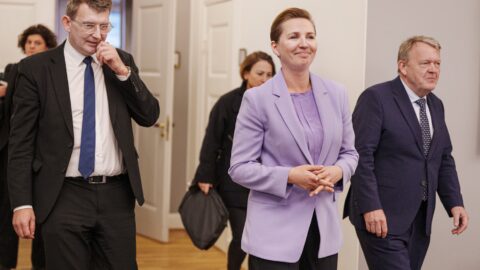
Denmark’s government talks have become the longest in the country’s modern parliamentary history, after 43 days of negotiations following the general election held on 24 March. The talks, led by acting Prime Minister Mette Frederiksen, have passed the previous record set in 2022, when it took 42 days after election day before a new governing arrangement could be announced.
Denmark’s coalition talks have passed the 2022 record
The negotiations have now lasted longer than any previous Danish government formation process of this kind. The earlier benchmark was set after the 1 November 2022 election, when Frederiksen announced the formation of the SVM government — a coalition between the Social Democrats (Socialdemokratiet), Venstre and the Moderates (Moderaterne) — 42 days after the vote.
The formal government formation in 2022 took place two days later, meaning the current process is also approaching the broader 44-day mark associated with the final establishment of that cabinet. The length of the talks reflects the fragmented result of the March election and the difficulty of building a majority around a stable political programme.
Mette Frederiksen is still trying to build a majority
Frederiksen is leading the negotiations as royal investigator and chief negotiator, the role given to the politician tasked with exploring whether a viable government can be formed. Talks have continued at Marienborg, the official residence of the Danish prime minister, where party leaders have been meeting in recent days.
The key arithmetic remains demanding. A majority in the Folketing, Denmark’s parliament, requires 90 seats. According to the reported post-election balance, the red bloc holds 84 seats, the blue bloc 77, while the Moderates hold 14 seats and remain central to the outcome.
This makes the Moderates, led by Lars Løkke Rasmussen, one of the decisive actors in the negotiations. Their position can determine whether Denmark moves toward a broader cross-bloc arrangement or a government anchored more clearly in the centre-left.
The Moderates remain the decisive force in Danish politics
The most likely scenario reported by Danish media points to a government composed of the Social Democrats, the Socialist People’s Party (Socialistisk Folkeparti, SF), the Moderates and the Social Liberal Party (Radikale Venstre). Such a cabinet would likely rely on external parliamentary support from the Red-Green Alliance (Enhedslisten) and The Alternative (Alternativet).
However, the Moderates have also indicated interest in a different arrangement. Løkke Rasmussen has argued that a new government should pursue an economic policy capable of increasing Denmark’s prosperity. His preferred model has reportedly involved the Social Democrats together with two centre-right parties, Venstre and the Conservatives (Det Konservative Folkeparti).
That divergence explains why the process has lasted so long. Frederiksen appears to prefer a government with a broader red parliamentary basis, while the Moderates are pushing for a more centrist or cross-bloc economic profile.

Why long negotiations matter for Denmark’s political system
Denmark is used to coalition governments and minority cabinets, but the current negotiations show how complex its parliamentary system can become when no bloc has a clear route to power. The country’s political tradition is built on compromise, but that compromise often requires detailed agreements on taxation, welfare, climate policy, labour market rules and public spending.
The talks also come after a period in which Danish politics has already moved beyond traditional bloc logic. The SVM government formed in 2022 was itself unusual because it brought together the Social Democrats with parties from the liberal centre-right. The current negotiations suggest that this cross-bloc experiment has not ended the tension between economic centrism and the expectations of left-leaning support parties.
A record that reflects a more fragmented Denmark
The length of the talks does not mean Denmark is without day-to-day administration. Until a new cabinet is appointed, the outgoing government continues as a caretaker government, handling current affairs while avoiding major political initiatives that would bind a future cabinet.
Still, the record-long negotiations underline a wider shift in Danish politics. Voters have produced a parliament where the balance of power depends on parties outside the traditional blocs, and where forming a government requires agreement across several ideological lines.
For Denmark and its Nordic neighbours, the process is another example of how stable parliamentary democracies are facing more fragmented political landscapes. The final agreement, when it comes, will show whether Frederiksen can build a government with a clearer centre-left profile or whether Denmark’s next cabinet will continue the cross-bloc approach that reshaped national politics in 2022.